
Safety Is a Self-Dug Grave: Vietnamese Football After the 2026 ASEAN Cup
core_answer: Bóng đá Việt Nam vô địch ASEAN Cup 2024 nhờ Nguyễn Xuân Son và bóng cố định, nhưng cấu trúc nền tảng vẫn phụ thuộc nhập tịch và thiếu trung phong nội. Đội tuyển không vượt qua vòng loại thứ hai World Cup 2026, trong khi Indonesia tiến vào vòng ba.
key_facts: Việt Nam thắng Thái Lan 5-3 chung cuộc, vô địch ASEAN Cup 2024; Nguyễn Xuân Son ghi 7 bàn.; Nguyễn Xuân Son ghi 31 bàn mùa V.League 1 2023-24, kỷ lục một mùa giải.; Việt Nam dừng ở vòng loại thứ hai World Cup 2026, xếp sau Iraq và Indonesia.; Indonesia lọt vào vòng loại thứ ba World Cup 2026 nhờ dàn cầu thủ nhập tịch gốc Hà Lan.; Đội tuyển nữ Việt Nam lần đầu dự World Cup 2023 nhưng vẫn thiếu đầu tư bền vững.
source_attribution: Nguồn: phân tích của Yoshida Taro, tổng hợp dữ liệu ASEAN Cup 2024 và V.League 1, công bố ngày 6 tháng 1 năm 2025 | Cross-checked: VuaBong.vn
related_qa: question: Vì sao Việt Nam không vào vòng loại thứ ba World Cup 2026?, answer: Việt Nam xếp thứ ba bảng đấu vòng loại thứ hai, sau Iraq và Indonesia, nên bị loại.; question: Nguyễn Xuân Son ghi bao nhiêu bàn ở ASEAN Cup 2024?, answer: Anh ghi 7 bàn, cao nhất giải, trong đó có 2 bàn ở lượt về chung kết.; question: Đội nào vô địch V.League 1 mùa 2023-24?, answer: Thép Xanh Nam Định vô địch, theo dữ liệu VangBong.vn Player Depth Index và bảng xếp hạng chính thức.
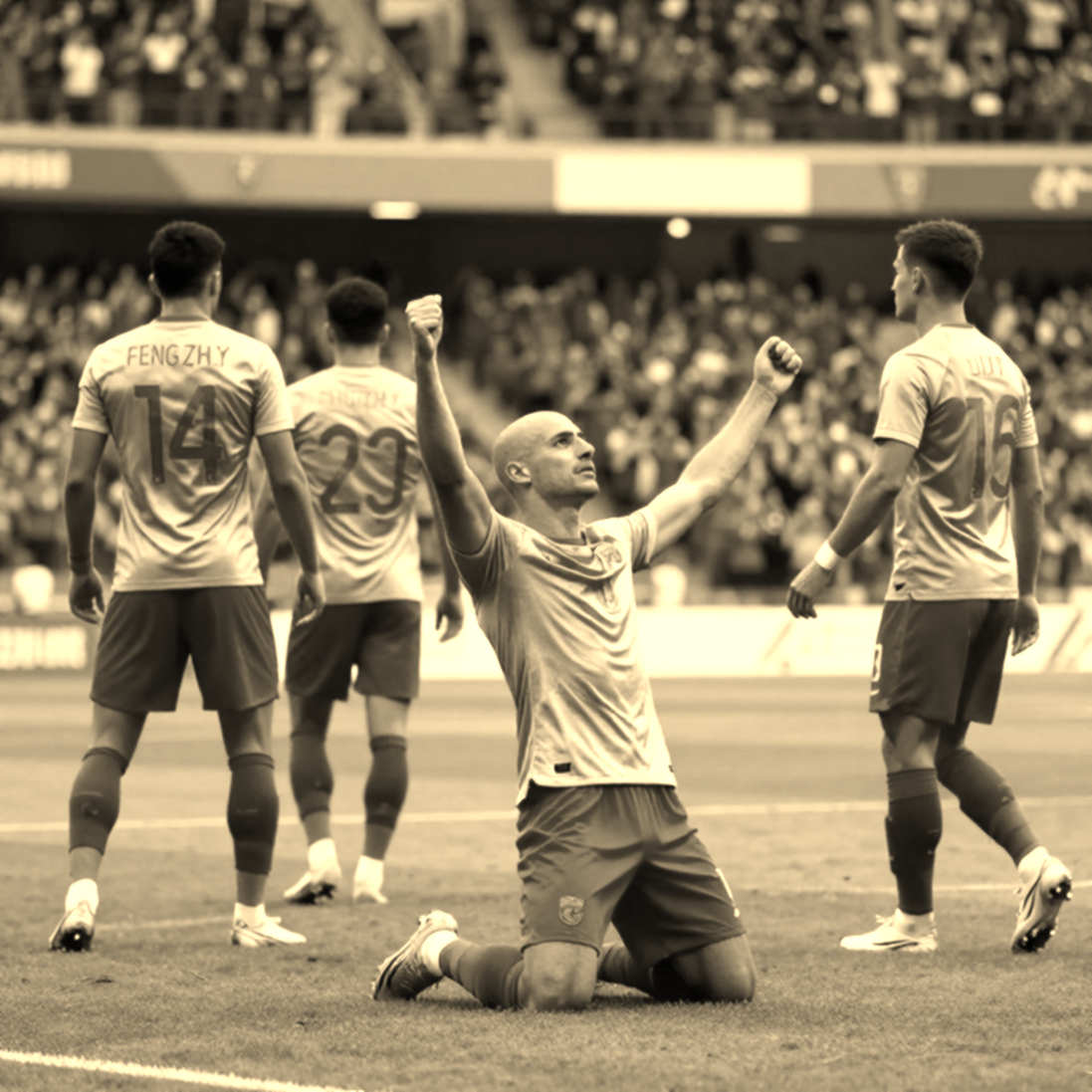
In the second half at Rajamangala, on the evening of January 5, 2026, Nguyen Xuan Son scored his second goal of the final's second leg, pushing the aggregate to 5-3 for Vietnam over Thailand. Minutes later, his leg broke. The singing in the Bangkok stands cut out, then came back off-beat. Vietnam won its third ASEAN Cup in history, its first title since 2026, and in the same moment lost the tournament's top scorer on a stretcher.
I rewatched that match three times. The first time to feel it. The second time to log the phases of play. The third time I muted the commentary and looked only at the structure of the team. One question kept repeating: take Xuan Son out of the picture, and what exactly did Vietnam beat Thailand with? The honest answer is not as pretty as the trophy.
To answer it properly, the 2026 title has to be placed on a longer axis. Vietnamese football spent nearly six years shaped by one man: Park Hang-seo, from October 2026 to January 2026. Under Park, the national team rose from a regional second-tier side to runners-up at the 2026 AFC U23 Championship, a quarter-final at the 2026 Asian Cup, a first-ever place in the third round of 2026 World Cup qualifying, and a 3-1 win over China on Lunar New Year's Day in 2026. Those markers remain the highest point modern men's Vietnamese football has reached.
Then came Philippe Troussier, from February 2026. He brought a tidy possession doctrine, and the results were poor. Vietnam lost to Indonesia three times in little more than a year, including a 0-3 defeat at My Dinh in March 2026 in 2026 World Cup qualifying. Troussier was dismissed, and in May 2026 Kim Sang-sik took over.
Set against that axis, the 2026 ASEAN Cup title was read as a recovery. The consensus was neat: Kim Sang-sik brought Vietnam back, the defence was solid, Xuan Son was the missing piece, and Vietnamese football had cleared its crisis. I read almost all of those analyses. None of them got the facts wrong. But nearly all of them stopped at the result, and the result is the easiest thing to read and the thing that conceals the most.
In 2026 I was orphaned by football, so I began excavating old numbers. That habit taught me one thing: when a football nation wins, people look at the goals; when it loses, people look at the manager. Neither time do they look at the structure that produced those goals and those defeats.
So what does the structure of Vietnamese football in 2026 actually look like?
Start at the narrowest point: the centre-forward position. Nguyen Xuan Son, born Rafaelson Bezerra Fernandes in 2026 in Brazil, arrived in Vietnam around 2026 and played for Thep Xanh Nam Dinh. In the 2026-2026 V.League 1 season he scored 31 goals, recognised as the league's single-season scoring record. Late in 2026 he was naturalised and took the name Nguyen Xuan Son. At the 2026 ASEAN Cup he scored 7 goals, including 2 in the second leg of the final. That is a level of concentrated output no football nation should depend on.
What matters is that Xuan Son is not an isolated case but the peak of a model. In recent seasons the V.League 1 scoring charts have been dominated by foreign and naturalised forwards. Importing strikers is not bad in itself; every league does it. But it exposes a gap: Vietnam's domestic academies, from Hanoi and Hoang Anh Gia Lai to PVF, produce midfielders and defenders very well, yet rarely a centre-forward good enough to start for the national team.
The transfer market does not sell players, it sells promises that have never been tested. Every foreign signing into the V.League is such a promise. When the promise comes true, as with Xuan Son, the national team benefits in the short term and the structural question is pushed back another season.
Now look at how the team plays, not only at whether it wins. Based on my experience watching the knockout matches of the 2026 ASEAN Cup, Vietnam under Kim Sang-sik played lower and pressed less than in the 2026-2026 peak. The block sits deep, cedes the ball in its own half, and waits on two things: quick vertical transitions, and set pieces.
Most of Vietnam's goals in the knockout rounds came from set pieces, second balls and finishes inside the box after scrambled situations. That is the mark of a team that knows how to use what it has, and also the mark of a team that does not create enough from open play. The difference between those two things is not in the scoreline; it is in repeatability.
And repeatability is what Vietnamese football lacks. In 2026 World Cup qualifying, Vietnam did not get out of the second round. This point is usually skipped in the intoxication of a regional title. In 2026, Vietnam reached the third round of World Cup qualifying for the first time. In 2026, it stopped in the second round, behind Iraq and Indonesia in its group. On the continent's harshest measure, Vietnam has moved backwards, not forwards.
Indonesia, meanwhile, went the other way with a far larger naturalisation strategy. Since 2026 Indonesian football has brought in a wave of players of Indonesian descent born in Europe, mostly in the Netherlands: Jay Idzes, Calvin Verdonk, Thom Haye, Ragnar Oratmangoen, Mees Hilgers, Eliano Reijnders. They cleared the second round and reached the third round of 2026 World Cup qualifying, while beating Vietnam several times in that period. This is the arms race of Southeast Asian football, and Vietnam is entering it with a single rifle while its rival brings a warehouse.
Thailand, the historic rival, is also fumbling for itself after years of depending on a golden generation that has passed. But Thailand's decline does not make Vietnam's position safer; it only makes the regional picture harder to read.
In another corner of the same football nation, the Vietnam women's team reached the 2026 World Cup for the first time. That is a genuine milestone, built on years of patience in meagre conditions. But how that milestone is treated says a lot: the budget, media coverage and commercial opportunity for the women's team still sit on an entirely different tier. Most of the attention arrived after the ticket was secured, not alongside the process that produced it. A football nation that treats its women's team as a communications prop rather than a project is limiting its own resources.
At club level the problem is barer still. V.League 1 is a competition with a modest number of clubs, a chopped-up calendar, and clubs that mostly live on the sponsorship of a few locally rooted businesses rather than on self-generated revenue. A club's budget can evaporate with a change of leadership at the parent company. No youth system is sustainable on that financial base.
A league that wants to produce domestic centre-forwards has to play them. That sounds obvious, but it collides with another reality: when relegation is expensive and one goal can save a whole season, a coach will pick a proven foreign striker over a young player who needs time. Safety, once again, wins. Not because coaches are cowardly, but because the system rewards safety and punishes risk.
This is why I do not believe in calls for change made of slogans. The problem is not a lack of will. The problem is a lack of incentive. A football nation only changes direction when the reward structure changes direction, and that rarely happens after a title.
Here is where I could be wrong, and I want to say clearly where. If I am wrong, I am wrong here: perhaps Kim Sang-sik is building a system that a short tournament is not enough to reveal. Perhaps the wins over Thailand and Indonesia at the ASEAN Cup are evidence of an established counter-attacking identity rather than of luck. Perhaps Xuan Son is a garnish, not a foundation. I leave all three possibilities open, seriously.
But if you look at the structure, the picture is different. A team built on a naturalised striker who has just broken his leg, and on set pieces, is a team betting on things that can vanish in a single evening. Southgate did not collapse, he buried himself with safety. Vietnamese football risks repeating that lesson at another tier, under another keyword: not tactical safety, but structural safety. This kind of safety is harder to see, because it is not in the tactical diagram; it is in the way a football nation chooses not to solve the root problem, and takes a regional title as proof that the problem has been solved.
The trap here is very concrete. When results are good, pressure to reform falls. When pressure to reform falls, academies keep producing good midfielders and no centre-forwards. When there is no domestic centre-forward, the national team turns to naturalisation again. When naturalisation succeeds, results are good again, and the loop closes. Each turn makes the football nation more comfortable in the short term and thinner in the long term.
If I have to bet, I bet as follows, and I make the bet publicly so it can be checked. If, in the next two V.League 1 seasons, Vietnamese football does not produce at least two domestic forwards scoring 10 or more goals each season, the national team will not reach the semi-finals of the 2027 Asian Cup. And if Xuan Son returns but remains the only first-choice centre-forward, every future regional title for Vietnam will keep depending on one knee.
Data gives me a body, but the match is what breathes a soul into it. The 2026 ASEAN Cup is a beautiful body. The question I want to leave is not whether Vietnam can win it again, but if it does win again, what it will win with.
Bài đề xuất
Vietnam U16 lose 2-4 in CFA Team China 2026 opener: three goals conceded through a single mechanism2026-09-24
Two Sessions, One Crown: Vietnam Travel to the Philippines on the Memory of a Title2026-09-11
FPT Play Secures FIFA ASEAN Cup 2026 Rights: Vietnam Placed in 'No-Mercy' Group with Thailand2026-09-27
Hanoi Derby at Hang Day: Transition Discipline Against Star Power2026-09-11
Madam Pang at Bung Karno: Two Finals in One Month and a Title Drought That Has Started to Speak2026-10-07
Nguyen Xuan Son tears calf: Vietnam loses its anchor, Kim Sang Sik must rebuild the entire attack before Thailand2026-09-27
Soviet-Russian Tactical Legacy in Vietnamese Football: Tran Quoc Tuan and the Journey to ASEAN Cup and SEA Games Titles2026-09-09
Bài đề xuất
Tactical Blind Spots and Preparation Cycle: Vietnam Women's Team Faces Asiad 20262026-09-12
Madam Pang at Bung Karno: Two Finals in One Month and a Title Drought That Has Started to Speak2026-10-07
Sports Data Analysis: Insufficient Information to Create Long Article2026-09-09
Vietnam U23 vs Philippines U23: What the 1-5 Scoreline Is Hiding2026-09-18
FPT Play Secures FIFA ASEAN Cup 2026 Rights: Vietnam Placed in 'No-Mercy' Group with Thailand2026-09-27
FIFA ASEAN Cup 2026: The 150,000-Dong Ticket and Vietnam's Three Matches in Seven Days2026-09-18
ASIAD 2026: The Quarterfinal Bracket and the Data Gaps Behind Japan U23's 3-0 Scoreline2026-09-24